Budgeting
The 50/30/20 Budget Rule, Explained With a Real Example
A simple budgeting framework that splits take-home pay into needs, wants, and savings — with a worked example and adjustments for high cost of living.
Last reviewed August 29, 2026
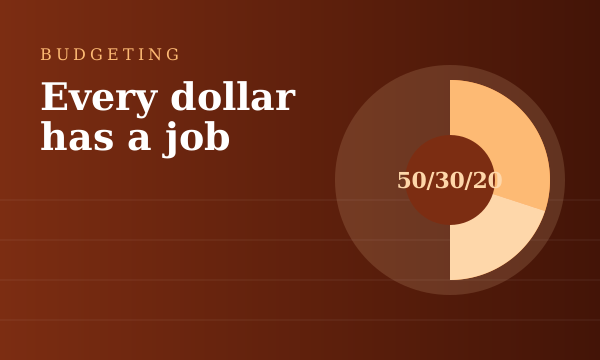
If budgeting feels complicated, the 50/30/20 rule is a good place to start. It replaces dozens of spending categories with three simple buckets, which makes it easy to remember and hard to abandon. Popularised by Senator Elizabeth Warren in her book "All Your Worth," the rule splits your after-tax income into 50% needs, 30% wants, and 20% savings and debt repayment.
This guide explains how each bucket works, provides a worked example, and shows how to adjust the ratios when your reality does not fit the textbook version.
What each bucket means
50% — Needs
Needs are the essentials you genuinely cannot go without: housing, utilities, groceries, transportation to work, insurance, and minimum debt payments. A useful test is to ask what would happen if you skipped the expense. If the answer involves eviction, a missed job, a penalty, or a shut-off notice, it belongs in needs. If the answer is "I would be a bit less comfortable," it belongs in wants.
30% — Wants
Wants are the things that make life enjoyable but are not strictly essential: dining out, streaming subscriptions, hobbies, travel, a nicer phone, gym memberships you could go without. Spending here is not the enemy — the rule simply keeps it bounded so it does not crowd out saving.
20% — Savings and debt
This bucket builds your future: emergency-fund contributions, retirement and other investing, and any debt payments beyond the minimums. Paying down high-interest debt belongs here because every dollar of interest avoided is effectively a guaranteed, risk-free return equal to the interest rate on the debt.
A worked example
Assume take-home pay is $3,500 per month. The rule allocates $1,750 to needs, $1,050 to wants, and $700 to savings and debt. In practice that might look like $1,300 rent and utilities plus $450 groceries and transport for needs; $1,050 for dining, subscriptions, and hobbies; and $700 split between an emergency fund, a Roth IRA contribution, and extra credit-card payments.
Real budgets rarely land perfectly on the target percentages, and that is fine. The value of the rule is the quick gut-check: if your needs are eating 65% of income, you know exactly where the pressure is coming from without needing a spreadsheet with fifty rows.
How to adjust for a high cost of living
In expensive cities, rent alone can push needs past 50%. Rather than abandon the framework, shift the ratios — for example 60/20/20 or 60/25/15 — and treat the original 50/30/20 as the direction to move toward as income grows or costs fall. The important discipline is protecting the savings bucket even when it shrinks: a consistent 15% you actually hit beats an aspirational 20% you never do.
How to start this week
Find your take-home pay on a recent pay-slip, list last month's spending from bank and credit-card statements, and sort each item into needs, wants, or savings. Compare the real percentages to the targets, then pick one bucket to adjust next month. An app is not required — a single spreadsheet or even a notes page works.
Frequently asked questions
- Should 50/30/20 use gross or net income?
- Use net (take-home) pay — what actually lands in your account after taxes and payroll deductions. Budgeting off gross income overstates what you have to work with.
- What if my needs are more than 50%?
- That is common in high-cost areas. Adjust the ratios (for example 60/20/20) and aim to move toward 50/30/20 over time. Protect the savings bucket even if you have to shrink it.
- Do minimum debt payments count as a need or as savings?
- Minimum required payments are a need (missing them has serious consequences). Any extra payments above the minimum belong in the 20% savings-and-debt bucket.
- Is 50/30/20 better than a zero-based budget?
- They serve different people. 50/30/20 is simpler and easier to maintain. Zero-based budgeting is more precise but requires more effort. Start with 50/30/20 and switch only if you want tighter control.
Related articles
Zero-Based Budgeting: How It Works and Who It Is For
Every dollar gets a job before the month begins. Zero-based budgeting is the most precise method available — here is how to actually run one without burning out.
How to Cut Your Monthly Bills Without Feeling Deprived
Most household budgets contain a few large recurring costs and dozens of small subscriptions. Focusing on the right ones creates real savings without changing how you live.
How to Budget on a Variable Income
Freelancers, contractors, and commission earners cannot budget from a steady paycheque. Here is a system that keeps a variable-income household stable month to month.